
Rotobrush Air Duct Cleaning in Flushing: A Homeowner’s Guide
Most homeowners never learn what equipment is actually working inside their ducts. They get a price, a truck pulls up, and an hour later the technician says everything is clean. That gap in knowledge is exactly where bad jobs hide. This guide explains how the Rotobrush BrushBeast works, why its brush-and-vacuum design performs differently from a portable vac, and what a Flushing homeowner should insist on seeing before the technician packs up.
A shop vac pulls roughly 150 CFM of suction. The Rotobrush BrushBeast pulls 450 CFM while a rotating brush knocks debris loose at the same moment. That isn’t a small step up. It’s a different mechanism entirely. If you’d rather leave it to a trained hand than rent a machine and guess, call (833) 468-5745 for a free estimate.
How does the Rotobrush BrushBeast actually work?
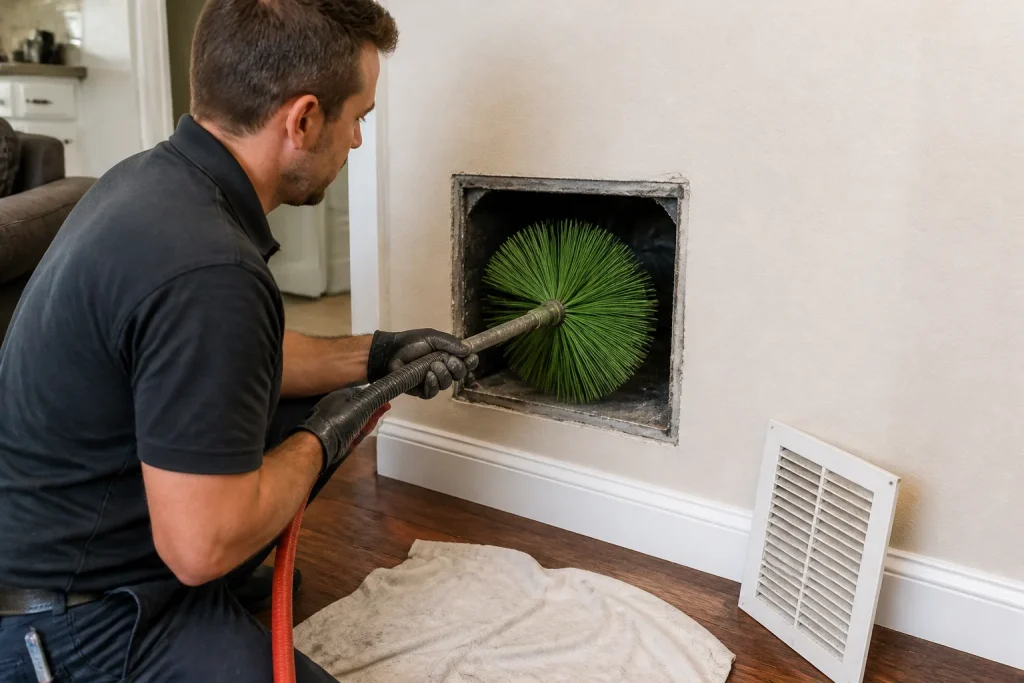
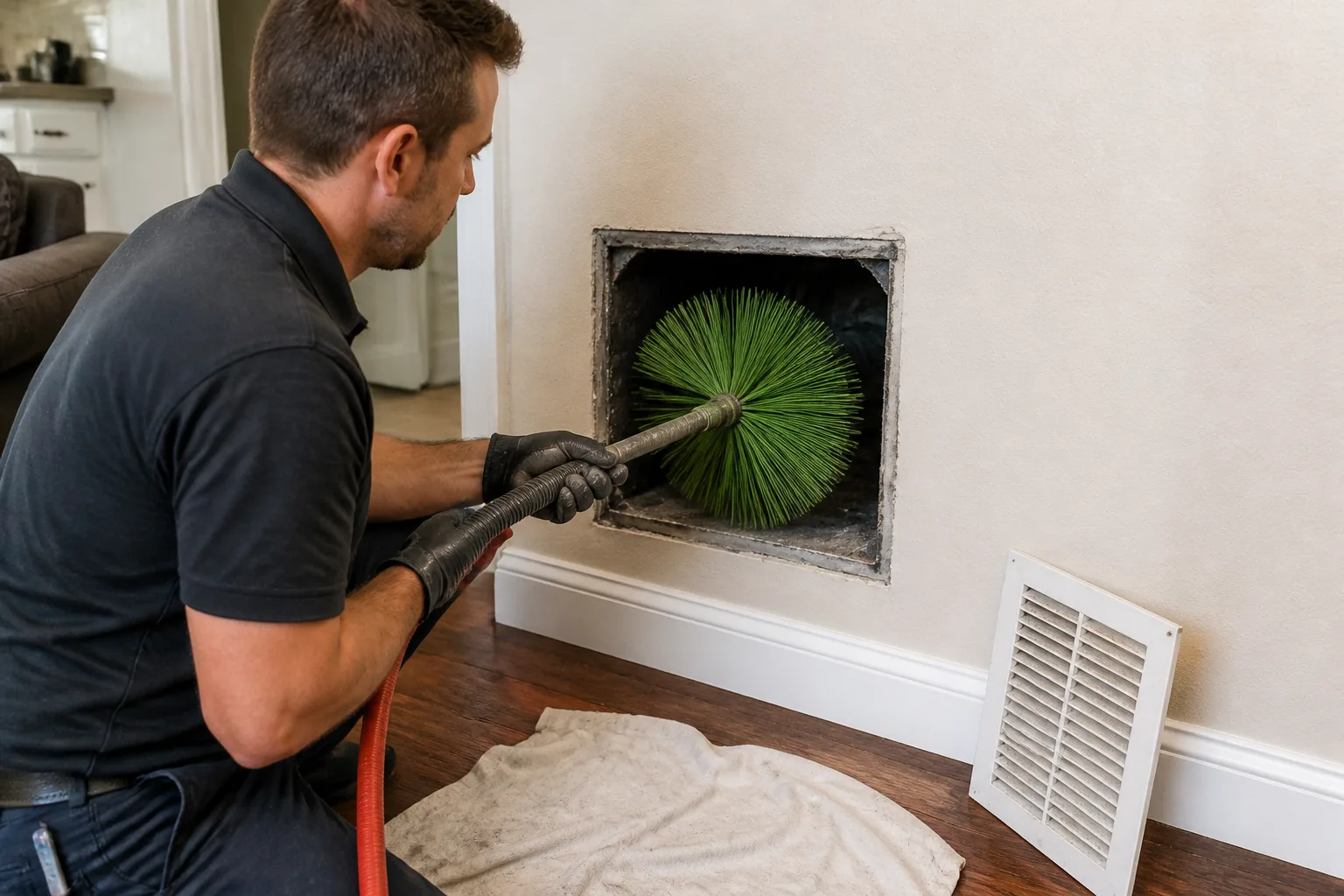
The BrushBeast is a rotary brush whip driven through a flexible shaft, combined with a high-volume vacuum pulling in the same pass. One motor spins the brush head against the duct wall; another drives the vacuum. Debris comes off the surface and goes into the collection unit in a single motion. That simultaneity is the point. Nothing knocked loose gets a chance to settle back down before suction catches it.
The system is built for the ducts people actually have: round galvanized trunks, rectangular plenum runs, flexible branches, and the transitions in between. The brush heads change size and stiffness for different duct diameters and materials, which matters in older homes where a rigid metal main can feed a soft flex branch two feet later.
What it isn’t: a shop vac with a fancy hose, or a fogging machine that sprays a biocide and calls the dust eliminated. We name our tools – Rotobrush, Nikro, Abatement Technologies – because transparency is part of the job. Ask us what equipment we’re bringing. We’ll tell you exactly.
Why does the brush-and-vacuum-at-once design beat brush-then-vacuum?
Sequence matters more than most people realize. A brush-then-vacuum approach loosens debris first, then tries to pull it away in a second pass. In that window, particulate drops out of suspension and settles into the duct floor, the seams, and the low points of a flex run. The second pass gets some of it. It rarely gets all of it.
The Rotobrush design couples the two actions at the source:
- Agitation and capture in one stroke. The brush head touches the wall and the vacuum pulls at the same point of contact.
- Consistent air velocity. The 450 CFM pull keeps debris moving toward the collection unit instead of drifting.
- Repeatable passes. Each duct run gets the same treatment, not a single optimistic swipe.
Compare that to a vacuum-only job. Vacuum-only cleaning pulls loose surface dust. It doesn’t break the bond between caked debris and the duct wall – and in a Flushing home with decades of accumulated build-up, the difference is easy to see in the camera footage. For homeowners who want the full picture of what air duct cleaning should involve, the mechanism is the place to start.
Why do older Flushing ducts respond differently to rotary brush systems?
Flushing has one of the widest housing age spreads in Queens. A pre-war house can sit a few blocks from 1980s construction, and each era handles rotary cleaning differently. Older flex duct, in particular, sometimes arrives at the job with a brittle inner lining. A stiff brush run at the wrong speed can damage it. A technician who knows the material adjusts the head and the feed rate before the first pass.
Galvanized sheet metal behaves the opposite way. It’s durable and holds up well to rotary agitation, but its seams and folds are traps. Debris collects in the locking joints and along the bottom of horizontal runs, and a vacuum-only pass skims right over it. The rotary brush works those edges, which is where a large share of the material actually sits.
Local climate feeds the problem. Flushing’s humid summers push moisture into return-air paths, and the mild shoulder seasons keep dust and pollen cycling through the house for months. Homes with window units or with returns routed near kitchens and bathrooms tend to show heavier build-up along those runs. Our technicians have up to 12 years of experience matching brush heads and vacuum settings to what a given duct run can handle, which is exactly the judgment a rotary system requires. When you book Air Duct Cleaning Flushing, that assessment is part of the job, not an upsell.
What should the Rotobrush’s built-in camera document before and after each run?
The Rotobrush system lets a technician record the inside of the duct while it’s being cleaned. That footage is the difference between a stack of claims and actual evidence. Before-and-after photos of your own ducts should be standard on any professional job, and if a company can’t or won’t provide them, treat the cleaning as unverified.
Here’s what the documentation should cover on each run:
- Pre-clean footage of the duct interior at the register boot, the mid-run, and the trunk connection.
- Visible build-up recorded before the brush enters, so the starting condition is on file.
- Post-clean footage of the same three points, captured from the same angle.
- Photos of the collection unit’s contents at the end of the job.
Ask to see it. A technician working with genuine Rotobrush equipment will have this footage already and can walk you through it in a few minutes. In our experience, a company using a generic rotary attachment tends to get quiet at that request.
How does negative pressure keep debris out of your living space?
Negative pressure means the cleaning equipment pulls air out of the duct system faster than the surrounding rooms can push air in. The duct network stays under a slight vacuum, so anything dislodged travels toward the collection unit rather than drifting out of an open register. Without it, a rotary brush just energizes dust and sends it into the room.
We deploy Abatement Technologies air scrubbers and containment equipment during service – the same category of gear restoration contractors use after a water loss or a smoke event. Registers get sealed or covered, the collection unit runs with high-efficiency filtration, and the scrubber handles any particulate that escapes the duct path. It’s a remediation-level standard applied to a routine cleaning, and the practical result is that you don’t come home to a fine grey film on the furniture.
How can you tell true Rotobrush equipment from a generic rotary brush?
You can’t judge this from the invoice. A company can write “rotary brush cleaning” on the paperwork and still show up with a $200 attachment from a hardware store. Ask three direct questions before the technician starts, and the answers will be clear enough to grade:
- “What’s the CFM rating on your vacuum unit?” A true Rotobrush rig is in the 450 CFM range. A generic rotary attachment run off a shop vac is far lower, and a vague answer is your signal.
- “Can I see the machine and the collection unit before you start?” Real Rotobrush equipment is identifiable and the technician should be glad to show it.
- “Will you give me before-and-after footage from inside my ducts?” The camera documentation is a routine part of the process on a genuine system. Refusal, or a promise to “send something later,” tells you what you need to know.
A fourth question works too: ask whether containment and a scrubber are part of the setup. Professional-grade equipment, not shop-vac shortcuts, is the standard we hold ourselves to on every job we take on in Flushing.
What else belongs in a full duct-to-dryer walkthrough?
A duct cleaning that stops at the supply registers leaves work on the table. The returns, the plenum, the air handler cabinet, and the dryer vent all sit in the same air ecosystem, and they all collect debris. Ask about a single appointment that covers the whole system rather than booking three separate visits.
On the filtration side, Honeywell and Aprilaire products are worth discussing after the cleaning is done, since a fresh duct network and a tired filter work against each other. Guardsman protective products finish the job by treating duct surfaces after cleaning. For the dryer side of the house, dryer vent cleaning addresses the lint load that builds up in a run most homeowners never see. And if the air handler itself is the source of the dust you’re seeing at the registers, HVAC cleaning gets into the coil and cabinet where a duct-only job won’t reach.
When to call a pro
If you’re seeing visible dust puff out of a register when the system kicks on, if a family member’s allergies spike every time the heat runs, or if you’ve just closed on a Flushing home and want a clean baseline before you unpack, the equipment list above is what you should be asking about. Same-day service is often possible. A shop vac in the hallway is not the same job.
Related services in Flushing: air duct cleaning, dryer vent cleaning, and HVAC cleaning.
The Bottom Line
The equipment inside your ducts during a cleaning job determines the outcome, and you’re allowed to ask what’s coming in the door. The Rotobrush BrushBeast pairs rotary agitation with 450 CFM of simultaneous suction, which handles older Flushing ductwork – brittle flex, seam-heavy galvanized metal – far better than a vacuum-only pass. Abatement Technologies containment keeps dislodged particulate out of your rooms. Before-and-after camera footage proves the work happened. One flat price per system, agreed before anything starts, keeps the invoice honest.
If you’re in Flushing and need help, Air Duct Cleaning Flushing offers free estimates – call (833) 468-5745. We answer 24/7. Fast dispatch from 7am to 7pm, Sunday through Friday.
Frequently Asked Questions
Pricing is set per job by a written estimate, not by a per-vent count or a coupon headline. Whole-system work typically runs higher than the teaser prices you see advertised, and that’s the honest trade-off: the low number usually buys a shop vac and a short visit. Call (833) 468-5745 for an exact quote – estimates are free.
Because the equipment is cheaper. A portable vacuum and a generic rotary attachment cost a fraction of a Rotobrush or Nikro rig, and the job takes less time. Cheaper quotes usually skip camera documentation, containment, and the scrubber. Ask what machine is coming to the house before you compare prices. Call (833) 468-5745 and we’ll tell you exactly what we bring.
You ask for the footage. A Rotobrush job produces before-and-after video of each duct run, plus photos of what came out. If a company can’t show you the inside of your own ducts, you have no way to verify the cleaning. Call (833) 468-5745 for a free estimate and we’ll walk you through the documentation process first.
It depends on the house. Pets, recent renovation dust, smokers, and allergy sufferers generally need it more often than a low-occupancy home with a well-maintained filter. A camera inspection tells you more than a calendar rule does. Call (833) 468-5745 – we’ll look at your system and give you a straight answer, not a subscription pitch.
Written by the team at Air Duct Cleaning Flushing.
Need Air Duct Cleaning Help?
Call Air Duct Cleaning Flushing - the local pro we connect you with is licensed and insured, here with fast help in Flushing.
(833) 468-5745