

Air Duct Cleaning: Repair or Replace? How Flushing Homeowners Decide
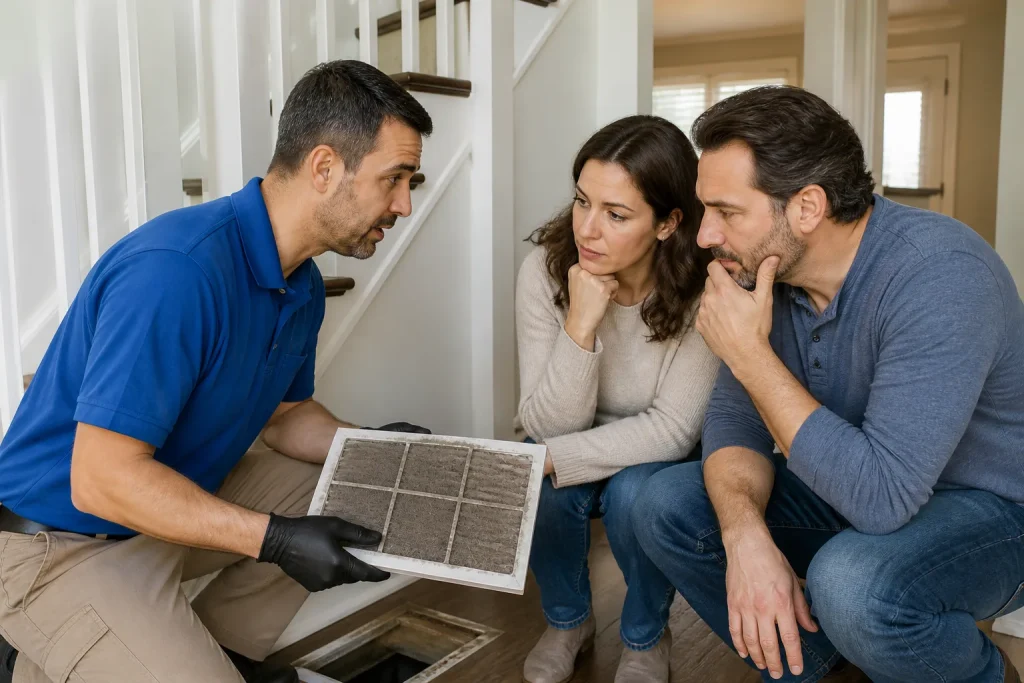
Cleaning a duct run with a 6-inch tear in the flex liner is like mopping a floor while a pipe leaks above it. The cleaning isn’t the problem; the sequence and the diagnosis are. Most Flushing homeowners who call us about duct cleaning are actually asking a different question: will cleaning fix this, or is the ductwork itself shot? You decide by inspecting first and looking at three things: liner condition, moisture, and the age of the building’s original materials. If the ducts can’t hold clean air after cleaning, you replace the failed section, not the whole house.
If you’d rather have a trained eye look before you commit, call (833) 468-5745.
Key Takeaways
- Cleaning a compromised duct system re-contaminates within weeks. Fix the condition first.
- Three conditions force replacement over cleaning: more than 25% flex liner compression, visible mold on interior duct surfaces, and pre-1978 ductwork with possible asbestos-wrap insulation.
- Zone-by-zone decisions usually beat blanket clean-or-replace calls in Flushing’s post-war attached homes.
- A camera inspection is the cheapest step in the whole process and the one that saves the most money.
What are the three conditions that push toward replacement over cleaning?
Three specific conditions mean cleaning won’t hold. We look for all three before quoting a duct cleaning in Flushing, because cleaning a system that fails any of them is money spent on a temporary result.
1. Flex duct with more than 25% liner compression. Flex duct has an inner liner that should stay round. When it’s crushed or sagging past roughly a quarter of its diameter, airflow drops and the liner itself becomes a trap for dust that cleaning can’t fully release. A rotary brush system like a Rotobrush can reach the surface, but it can’t restore a collapsed liner to its original shape.
2. Visible mold growth on interior duct surfaces. Not the dust you see at a register – that’s normal. We mean actual growth inside the duct run, which usually signals a moisture source: a leaking coil, a disconnected joint drawing humid air, or condensate that can’t drain. Cleaning without fixing the moisture just resets the clock.
3. Ductwork installed before 1978. Flushing’s older building stock sometimes includes original duct runs wrapped in insulation that may contain asbestos. That’s a remediation matter, not a routine cleaning, and it has to be handled by a specialist before any cleaning equipment goes in. The rest of the system can often be cleaned; the suspect section gets addressed separately.
What does a HEPA extraction unit reveal that a shop vac misses?
Airflow resistance, mostly. An Abatement Technologies HEPA extraction unit pulls air through the system under controlled negative pressure, and the readings during the job tell us something a camera alone can’t: whether there’s a breach or an obstruction the eye can’t reach. A camera shows surfaces. Resistance tells you how the air moves through them.
In practice, that means a hidden tear in a flex branch, a disconnected joint behind drywall, or a crushed section under a floor shows up as an airflow anomaly before we’ve found it visually. A standard shop vac doesn’t hold enough negative pressure to register that difference – it cleans what it can see and moves on.
Containment matters here too. Abatement Technologies scrubbers keep dislodged particulate captured during service rather than redistributed through the home. For a Flushing homeowner with allergies, or a family with young kids and pets, that’s the difference between clean and “clean, mostly.”
What’s the real cost comparison: clean, repair a section, or replace?
The three options price out very differently, and the cheapest choice depends on the diagnosis. These are typical ranges for a standard home, and the written estimate is what sets your final price.
| Option | Typical range | When it’s the right call |
|---|---|---|
| Full system cleaning | $300 – $500 | Ducts are intact; contamination is dust and debris, not damage or mold |
| Section repair (per zone) | $200 – $400 | One or two runs are compromised; the rest of the system is sound |
| Full flex duct replacement | $1,500 – $3,500 | Widespread liner compression, mold throughout, or pre-1978 insulation concerns across the system |
Here’s the honest logic. Paying $300 to $500 to clean a system with a torn liner in one branch is fine – if you repair that branch in the same visit. Cleaning without the repair gets you two weeks of cleaner air and a slow slide back to where you started. Section repair at $200 to $400 per zone is often the sweet spot in Flushing’s mixed duct systems.
Why does the inspection come first?
Inspection before quoting is the protocol we follow, and it’s what a reputable company should offer on any system older than about 15 years. Cleaning is easy to sell and hard to diagnose without looking, so the inspection isn’t optional – it’s the part that determines whether the rest of the job is useful.
A proper inspection covers:
- Camera survey of the main trunk and at least one branch run
- Liner condition at every accessible flex joint
- Moisture readings at the coil and any cold-duct transitions
- Visible insulation materials reported to you before any disassembly
We name our tools – Rotobrush rotary brushes, Nikro cleaning rigs, Abatement scrubbers – because transparency about equipment is part of a fair quote. If a company won’t show you a camera image of your own ducts, ask why. A Flushing homeowner deciding between repair and replacement should see the evidence before spending the money.
Why Flushing’s housing mix needs zone-by-zone decisions
Flushing’s post-war attached homes typically have original galvanized trunk lines with later-added flex branch runs tacked on over the years. That hybrid layout rarely fits a single clean-or-replace answer. The galvanized trunk is often in decent shape; the flex branches added later are the ones compressed, disconnected, or sagging.
The result is that a blanket quote to “replace the ducts” may be overbilling work that doesn’t need doing, and a blanket quote to “clean everything” may ignore the branches that will re-contaminate the trunk. The right approach is zone by zone: clean the trunk, assess each flex branch on its own condition, and repair or replace only the runs that fail.
We see this pattern across neighborhoods like Murray Hill and downtown Flushing, in walk-ups and attached homes from the same building era. The decision isn’t about the neighborhood – it’s about what each duct run looks like after 40-plus winters of use.
When to call a pro
If you’ve checked the registers, run the system a while, and still notice dust settling faster than usual, or if anyone in the house has worsening allergy symptoms that track with HVAC cycling, it’s worth a call. Don’t open ductwork yourself – hidden liner damage and pre-1978 insulation are exactly the things that require training to spot safely.
Related services in Flushing: professional air duct cleaning, dryer vent cleaning, and full HVAC cleaning all on one call. If you’re also touching the filter end of the system, we carry and service Honeywell and Aprilaire filtration products so clean ducts aren’t feeding through a weak filter.
The Bottom Line
Cleaning vs. replacement isn’t a coin flip. It’s a diagnosis. Look for flex liner compression over 25%, interior mold growth, and pre-1978 insulation concerns. If any of those are present, cleaning alone will likely re-contaminate the system and the cleaning money is spent for a short-lived result. If none are present and the contamination is dust, cleaning does the job.
If you’re in Flushing and need help deciding, Air Duct Cleaning Flushing offers free estimates. Call (833) 468-5745. We answer 24/7. Fast dispatch from 7am to 7pm, Sunday through Friday. We’re closed Saturday, and our technicians have up to 12 years of experience on professional-grade equipment.
Written by the team at Air Duct Cleaning Flushing.
Need Air Duct Cleaning Help?
Call Air Duct Cleaning Flushing - the local pro we connect you with is licensed and insured, here with fast help in Flushing.
(833) 468-5745