
Top Signs You Need Air Duct Cleaning Service – Don’t Ignore These
Visible dust on your supply registers is actually one of the least urgent signs of a dirty duct system. A system packed with compacted debris often looks clean at the surface because nothing is moving through it efficiently enough to deposit particles. What matters is reading each symptom for what it tells you about the contaminant behind it. If you’d rather have someone look instead of guess, call (833) 468-5745.
What Are the Real Signs You Need Air Duct Cleaning?
The real signs are patterns, not single events. One dusty vent after a windy week is normal. Dust returning within days of cleaning, rooms that never match the thermostat, a musty smell that shows up when the system starts, or allergy symptoms that ease when you leave the house and return when you come back: those are diagnostic clues. Each one points to a different kind of problem inside the duct system, and knowing which one you have changes what the technician should be checking.
Here’s how we map the common symptoms to their likely causes:
- Uneven room temperatures usually point to a damper stuck partway closed or debris obstructing a branch run, not a failing furnace.
- A musty odor at startup often signals biological growth on or near the evaporator coil, where condensation keeps surfaces damp.
- Heavy dust at the registers frequently means a breach on the return side pulling attic or wall-cavity particulate into the airstream.
- Allergy symptoms that track with system runtime suggest fine particulate is being recirculated rather than filtered out.
- Rising energy bills with no other explanation can trace to restricted airflow from debris on the blower wheel.
When you can describe the pattern precisely, a technician arrives knowing where to look first. That’s worth more than a vague “my allergies are bad.”
Why Visible Dust Is the Least Urgent Sign
Surface dust is the sign most homeowners notice first, and it’s the one that tells you the least. A lightly soiled system moving plenty of air will dust your registers because particles are still traveling. A heavily clogged system may show almost nothing on the grille because the airflow that would carry debris to the surface has dropped. In our experience, that quiet system is often the one that needs attention sooner.
What you want to watch instead is dust behavior over time. If you wipe a register and it stays clean for weeks, airflow and filtration are working. If dust reappears in days, the source is upstream and ongoing. That source could be a return-side leak, a filter that’s bypassing at the edges, or construction dust still working its way through.
The fix isn’t always “clean the ducts.” Sometimes it’s sealing a return, upgrading filtration, or correcting a filter that doesn’t fit its frame. A proper look tells you which. Call (833) 468-5745 if you’d like us to take that look.
Musty Odors and What They Tell You About Your Coil
A musty smell that appears when the system kicks on is a distinct clue. It usually means moisture is sitting somewhere it shouldn’t, and the most common location is the evaporator coil and its drain pan. The coil stays wet during cooling season. Dust that settles on a wet surface becomes a food source for biological growth, and the airstream carries that smell into every room.
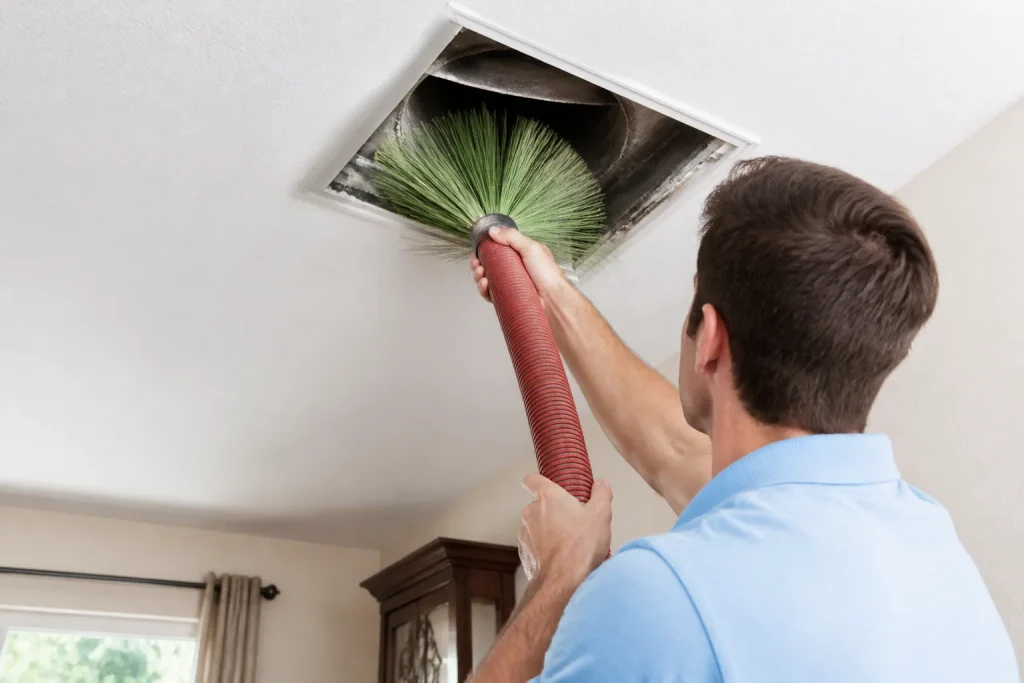
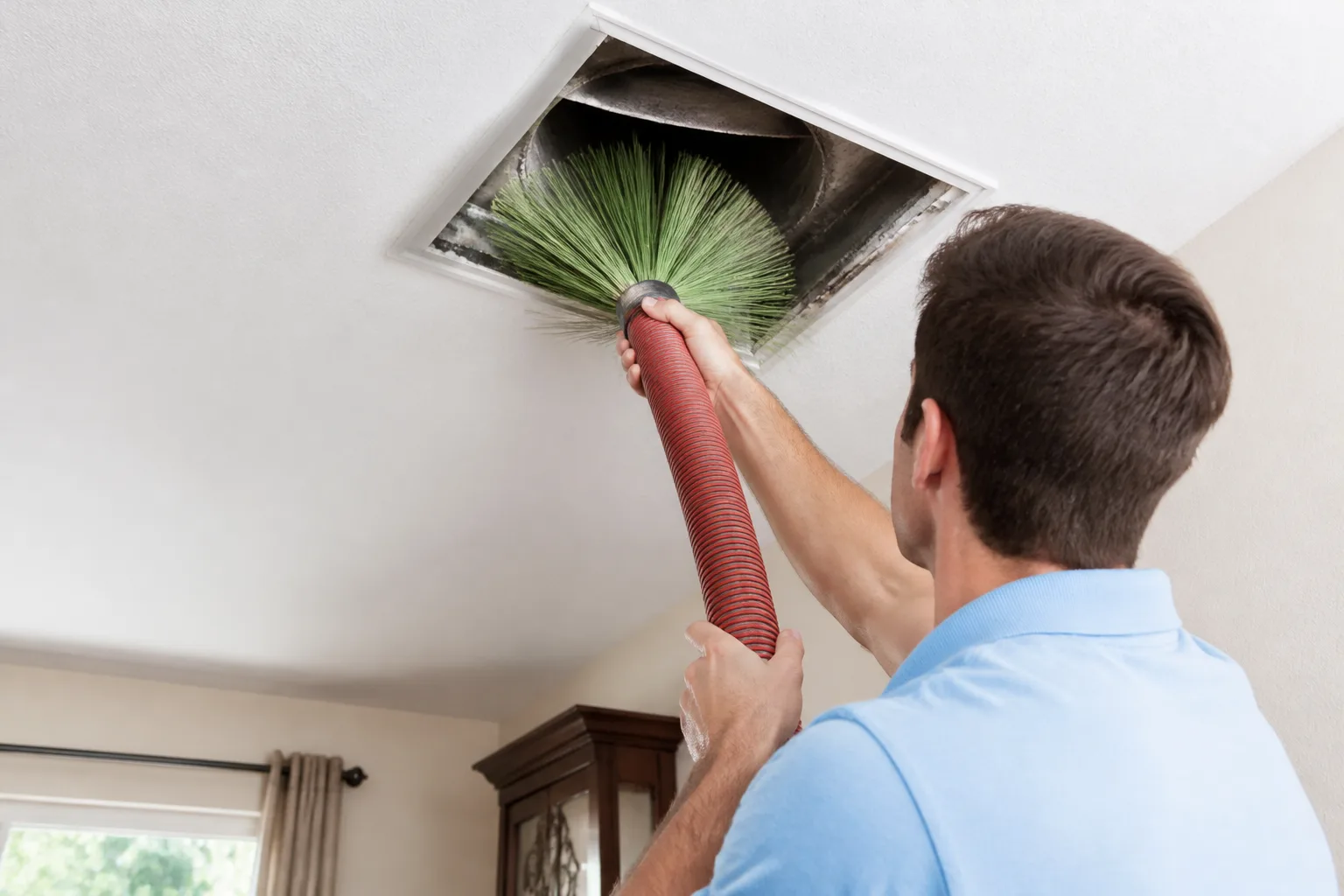
Cleaning the ducts alone won’t solve this. It requires cleaning the coil and the air handler along with the ductwork, which is why we treat full HVAC cleaning as its own service rather than a bundle. Nikro-powered cleaning rigs let us reach the coil and cabinet without dismantling the system beyond what’s safe.
A smell that comes and goes with weather can also trace to a disconnected joint pulling air from a crawlspace or wall cavity. That’s an inspection question, not just a cleaning one.
Duct Integrity: When Cleaning Isn’t Enough
Some signs point to a damaged duct system where cleaning alone won’t fix the problem. If you notice these, ask for an inspection alongside the cleaning:
- Torn or separated flex duct visible at accessible joints
- Visible mold growth on duct surfaces or insulation
- Pest activity or droppings inside the system
- A sharp rise in dust after any renovation or roof work
- Whistling or roaring at registers, which can indicate a disconnected joint
Cleaning a system with compromised ducts just moves debris into the same leaks. The professional standard is to clean, then repair or seal the breach, then verify airflow. Abatement Technologies air scrubbers run during the work to capture particulates as they’re dislodged, which matters more when the system is already compromised.
How Flushing’s Housing Stock Changes the Equation
Most online checklists are written for single-family suburban homes, and they miss the biggest factor in Flushing: attached row houses and converted multi-family buildings share walls, chaseways, and sometimes duct chases. That creates cross-contamination paths a freestanding house simply doesn’t have.
In our experience, a musty smell or dust plume in one unit of a converted multi-family can often be traced to a return shared or adjacent to another unit. Duct runs in older attached homes also pass through unconditioned wall cavities, pulling whatever is in that space when a joint fails. Renovation work in one unit can send drywall dust into a neighbor’s system through the same pathways.
If you’re in a converted multi-family, mention it when you call. The technician should know to check shared chases and return connections, not just your visible grilles.
The Energy Efficiency Signal: Airflow and Static Pressure
Debris accumulation on a blower wheel can reduce airflow by 15 to 20 percent. That’s a measurable number, and it shows up in two places: your energy bills and a static pressure test. A technician who knows what to look for can read static pressure across the system to see whether the blower is fighting a restriction.
Restricted airflow means the system runs longer to reach the thermostat setpoint, which costs more and puts wear on the blower motor. It’s a quiet problem. Homeowners often notice the bill before they notice anything else.
This is also why we run Rotobrush rotary brush systems rather than a shop vac: the rotary action loosens compacted debris from duct walls and the blower, where a consumer vacuum can’t reach. Call (833) 468-5745 for a free estimate if your bill has climbed without an obvious reason.
The Post-Renovation Trigger
Drywall dust is a specific problem. It’s far finer than the particles your standard filter is designed to catch, and it’s abrasive. It bypasses a standard 1-inch filter, travels the return, and settles into duct liner and coils. You may not see the damage until months later, when airflow has dropped or the coil starts to smell.
If you’ve had any drywall work, sanding, or a major renovation in the last year, that alone is a reason to inspect the ducts. A renovation in an attached Flushing home can also push drywall dust into a neighboring unit through shared returns.
Cleaning after renovation isn’t optional maintenance. It’s removing an abrasive contaminant before it shortens the life of the blower and coil.
When to Call a Pro
If you’ve checked your filter, sealed what you can reach, and the pattern persists, it’s time to have someone measure instead of guess. We can supply and install Honeywell and Aprilaire filtration products after cleaning to help prevent buildup from returning. A professional-grade cleaning with proper containment is not a step to take on with a rented vacuum.
Related services in Flushing: if your dryer vent cleaning is overdue, we cover that under the same visit, and full HVAC cleaning handles the coil and blower. You can read more about air duct cleaning on its own page.
Key Takeaways
- Surface dust is the least urgent sign; a clogged system often looks clean.
- Match symptoms to causes before you call: uneven temps, odor, dust pattern, and health symptoms each point somewhere specific.
- Flushing’s attached and converted multi-family housing creates cross-contamination paths that single-family checklists ignore.
- Debris on a blower can cut airflow 15 to 20 percent. A static pressure test measures it.
- After renovation, drywall dust bypasses standard filters and needs professional removal.
The Bottom Line
The best way to read your duct system is to treat symptoms as clues, not as a checklist to tick off. Odor, airflow, dust behavior, and your energy bill each point somewhere different, and a technician who understands those clues can tell you whether you need cleaning, inspection, or both. If you’re in Flushing and need help, Air Duct Cleaning Flushing offers free estimates. Call (833) 468-5745. We answer 24/7. Fast dispatch from 7am to 7pm, Sunday through Friday.
Frequently Asked Questions
If the filter is fresh but dust returns within days, if you smell mustiness at system startup, or if airflow is weak at some registers and strong at others, those point to the ducts themselves. A filter change won’t fix an upstream breach or a dirty blower. Call (833) 468-5745 for a free estimate.
Yes, that pattern is one of the more reliable clues. If symptoms ease when you leave and return when you’re back, fine particulate or biological growth is likely being recirculated. It’s worth having the system looked at before assuming it’s purely seasonal. Call (833) 468-5745 to schedule an inspection.
Yes. Drywall dust is finer than a standard filter catches and abrasive to the blower and coil. Visible condition doesn’t tell you what’s embedded in the duct liner. Cleaning after renovation removes it before it wears on the system. Call (833) 468-5745 for an estimate.
There’s no universal schedule. A home with pets, allergy sufferers, or recent renovation usually needs attention sooner than a low-occupancy home. Watch for the symptom patterns above instead of following a fixed calendar. Call (833) 468-5745 to talk through your situation.
Written by the team at Air Duct Cleaning Flushing.
Need Air Duct Cleaning Help?
Call Air Duct Cleaning Flushing - the local pro we connect you with is licensed and insured, here with fast help in Flushing.
(833) 468-5745